
Authorized Dealer
Unlike many photographic films, the CCD or CMOS of a digital camera is inherently susceptible to infrared contamination, even when the manufacturer attempts to reduce this problem by adding an infrared-absorbing filter…
Product highlights and buying context
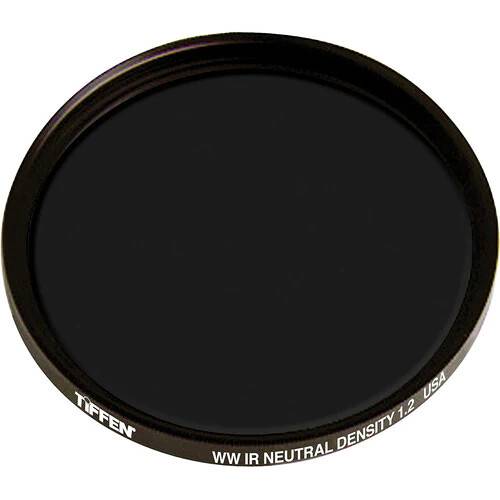
Unlike many photographic films, the CCD or CMOS of a digital camera is inherently susceptible to infrared contamination, even when the manufacturer attempts to reduce this problem by adding an infrared-absorbing filter on top of the image sensor. Because these filters do not have a sharp cutoff at the infrared wavelengths there has to be a compromise in order not to exclude visible red wavelengths. This results in some infrared wavelengths being allowed to pass.
While minor infrared contamination does not normally cause much of a problem for visible images, when using conventional neutral density filters, especially denser grades, this issue is multiplied by the filter factor. Tiffen has now addressed this problem with the introduction of its exclusive line of their Infrared Hot Mirror filters. Hot Mirror filters completely block infrared light throughout the entire spectrum.
Tiffen's Water White ColorCore glass is produced through a process that entails permanently laminating the filter material in between two pieces of optical glass that are ground flat to tolerances of 1/10,000th of an inch, then mounting them in precision aluminum rings.
As with all Tiffen filters, IRND filters are ground and polished to provide the greatest level of flatness and parallelism. This, together with their exclusive ColorCore technology, ensures the highest level of optical quality
Tiffen's ColorCore glass is sealed between two optical glass sheets. In this way, Tiffen can better control the various densities of their filters and thereby create more exact degrees of filtration. This process makes for greater accuracy of color as opposed to glass that is simply dyed and becomes subject to deviation during the dye process
The ColorCore process allows Tiffen to control the color and density of their filters, and the characteristics of special effects filters with much greater accuracy than typical dyed-in-the-mass filters, which usually exhibit color and density variations
Additional Details
Loading…
